"Stellar Manufacturing," with facilities in both Germany and India received its Q1 2025 utility bills, presenting management with a stark reality: costs at its German plant had surged by 38% year-over-year, while expenses at its Indian facility remained stable. This single invoice vividly illustrates the current truth of global industrial electricity prices—it's not a uniform "increase" but a severe "Great Divergence."
Energy costs, once a predictable operational factor, are now reshaping the global competitive landscape in unprecedented ways. Understanding this "divergence," driven by energy mix, geopolitics, and extreme weather, and shifting from passive acceptance to active management has become crucial for building future core competitiveness.
Mapping the New Global Electricity Price Landscape
The current global price map is being torn by three forces: volatility in traditional fossil fuel prices, the growing pains of the green transition, and the "power hunger" driven by AI and electrification. The result is stark regional contrast.
| Region | H1 2025 Price Trend | Key Drivers |
|---|---|---|
| European Union | Persistently High & Volatile | Dependence on imported natural gas; high system balancing costs due to intermittent renewable generation; internalization of carbon costs. |
| United States | Significant Increase, Regional Strain | Rising natural gas prices; explosive growth in data center load; grid upgrade pressures. |
| China | Generally Stable under Policy Regulation | Guaranteed by a diversified energy structure and strong grid coordination. |
| India | Stable with Slight Decrease | Low international coal prices; increased domestic generation capacity. |
| Australia | Decreasing in Renewable-Rich Areas | World-leading rooftop PV penetration often drives daytime prices near zero. |
Analysis: The Three Forces Driving the Global Price Divide
1. Force One: The "Asymmetric" Shock of Energy Fundamentals
European electricity prices remain deeply tied to natural gas, making the region a "price taker" in the global market. In contrast, regions with abundant domestic coal or hydro resources possess a natural "buffer." This difference in resource endowment is the geological foundation of the price split.
2. Force Two: The "System Cost" of the Green Transition Becomes Visible
Take Germany as an example. Although renewable energy accounted for over 50% of generation in Q1 2025, with frequent negative pricing occurrences, the final electricity price for industrial consumers did not drop proportionally. The reason is that the costs for grid upgrades, backup capacity, and balancing services required to support high renewable integration are passed on to consumers through levies and taxes. The green power itself is cheaper, but the "system ticket" to use it has become more expensive.
3. Force Three: "Power-Hungry" Demand Triggers Local Shortages
Global data center electricity demand is projected to double within the next two years, equivalent to the total consumption of a medium-sized country. This concentrated, rigid, and rapidly growing demand has already caused grid congestion in areas like Virginia, USA, and Dublin, Ireland, pushing regional wholesale prices to 2-3 times the national average.
Business Impact: Reshaping Costs, Location Strategy, and Competitiveness
This divergence is triggering a chain reaction:
Erosion of Cost Control: For businesses in high-price regions, savings from traditional energy efficiency measures pale in comparison to the surge in electricity rates.
Overturned Location Logic: "Predictable energy security and cost" is surpassing labor and taxes as the primary consideration for industrial investment. Many energy-intensive industries have already begun a new round of global capacity repositioning.
Materialization of Supply Chain Carbon Costs: Policies like the EU's Carbon Border Adjustment Mechanism (CBAM) mean factories in Europe using expensive green power face completely different compliance costs and market access conditions compared to overseas factories using cheap but carbon-intensive electricity.
The Solution: Transforming Energy from a Cost Center into a Strategic Asset
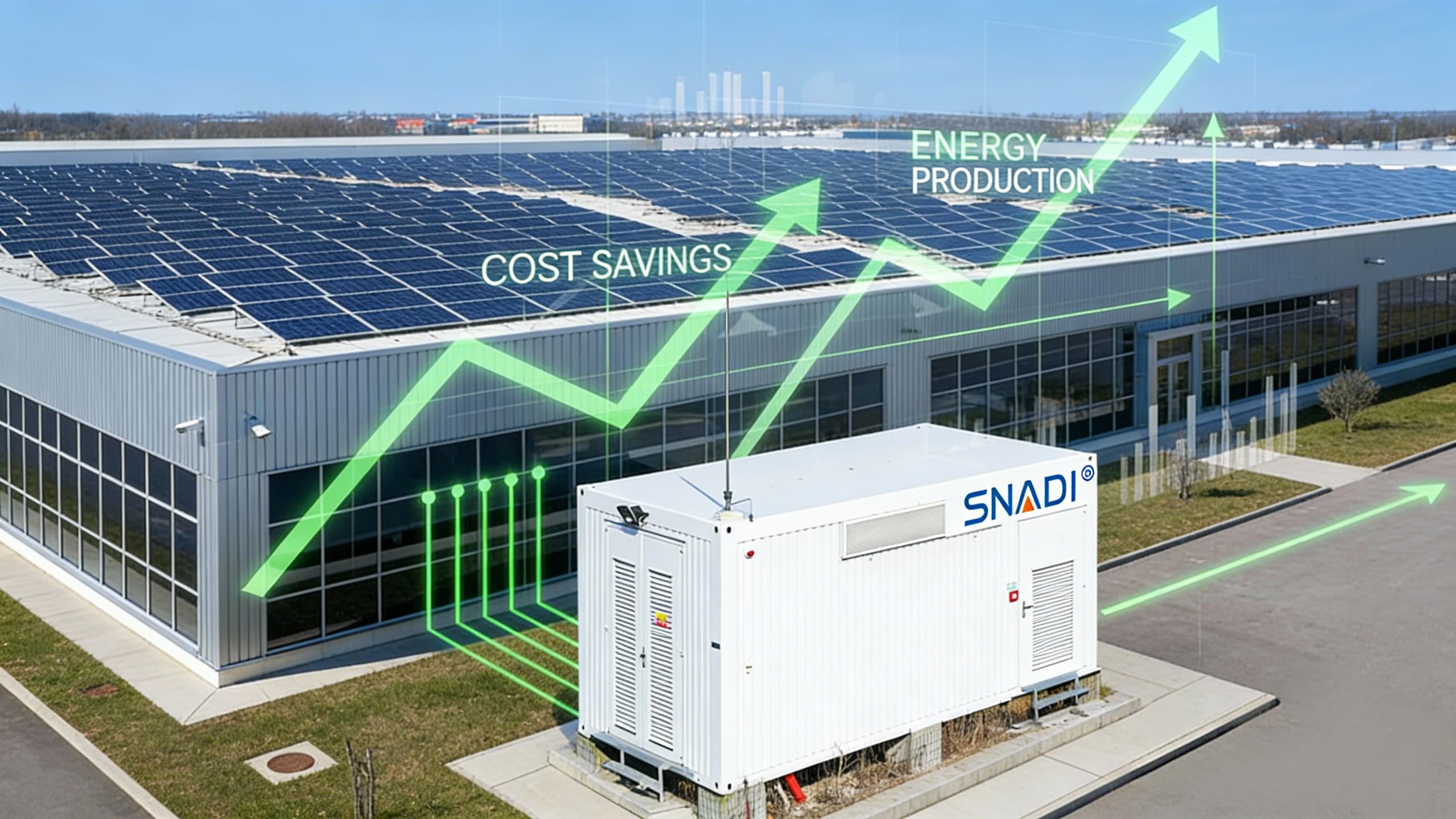
Facing this divide, leading companies are elevating energy management to a C-suite strategic priority. The core path is investing in corporate-level distributed energy systems centered on "PV + Energy Storage."
Why is this the ultimate solution?
Cost Lock & Hedge: The Levelized Cost of Energy (LCOE) for solar PV is now generally lower than industrial retail electricity rates. Building your own generation asset is akin to locking in fixed-cost power for 25 years, completely hedging against market volatility.
Resilience Building: Energy storage systems can ensure continuity for critical production during grid outages and discharge during peak price periods for arbitrage, effectively creating revenue.
Monetizing Green Competitiveness: Self-generated renewable energy is the most robust credential for meeting CBAM and supply chain decarbonization requirements, which can translate directly into product premiums or order advantages.
How SNADI/SNAT Solar Empowered "Stellar Manufacturing" to Navigate the Divide
"Stellar Manufacturing," a precision components company with plants in Germany (high-price) and India (low-price), needed a globally optimized strategy, not a one-size-fits-all solution, to address its disparate energy challenges.
The customized cross-regional solution provided by SNADI/SNAT Solar:
| Facility Location | Core Challenge | SNADI/SNAT Solar Customized Solution | Key Value & Outcome |
|---|---|---|---|
| Bavaria, Germany Plant | High & volatile prices; significant carbon neutrality pressure. | 2.8MW Rooftop PV + 1.5MWh Battery Storage + Intelligent Energy Management System. Design emphasizes storage for peak shaving/backup. | 1. Cost Reduction: Covers 60% of daytime load, reducing overall electricity costs by 42% with a payback period of 4.8 years. 2. Resilience: Ensures uninterrupted operation of critical lines during grid instability. 3. Green Credential: Achieved local green production certification and met core clients' decarbonization requirements. |
| Gujarat, India Plant | Stable but reducible costs; future carbon tax risk. | 1.5MW Rooftop PV (minimal storage), focusing on maximizing self-consumption. Utilized cost-effective string inverter solutions tailored to local policy. | 1. Cost Reduction: Achieved a further 18% reduction in energy costs on an already low base. 2. Future-Proofing: Prepared infrastructure for potential future carbon constraints, enhancing the site's long-term asset value. |
Through this integrated approach, Stellar Manufacturing not only mitigated the risks posed by the price divergence but transformed its energy burden into a cross-regional competitive advantage. The cost disadvantage at its German plant was significantly reduced, while the operational edge of its Indian facility was consolidated and enhanced.
Action Plan: Three Steps to Initiate Your Energy Strategy Transformation
Diagnosis & Mapping: Clearly answer: What is your load profile? What is your available rooftop/land area? What are the local policies and solar resources?
Techno-Economic Modeling: Conduct preliminary financial and technical feasibility analysis based on your data.
Selecting a Global Partner: Choose a partner like SNADI/SNAT Solar that possesses cross-regional project experience and offers full lifecycle services—from financing and technical design to engineering implementation and long-term smart O&M. They should understand the rules of different markets and provide you with a detailed Cross-Regional Energy Strategy Investment Analysis Report based on your actual data.
Conclusion:
The Crisis of Divergence is a Window for Leaders: The great divergence in global electricity prices is a clear test of every company's energy resilience and strategic foresight. Passive observers see a cost crisis, while proactive planners see a historic opportunity to transform energy from a cost center into a profit center and engine of competitiveness. This transition is urgent. The energy decisions you make today will directly define your company's position in the global industrial chain for the next decade. We recommend starting with a professional consultation from a global perspective. Contact the SNADI/SNAT Solar International Team to request your customized Corporate Energy Strategy Assessment Framework in the Context of Global Price Divergence. Let us help you not just withstand the global energy shift, but lead through it.
✉️Email: exportdept@snadi.com.cn
Website:
www.snadisolar.com
www.snatsolar.com
☎️WhatsApp / WeChat: +86 18039293535